

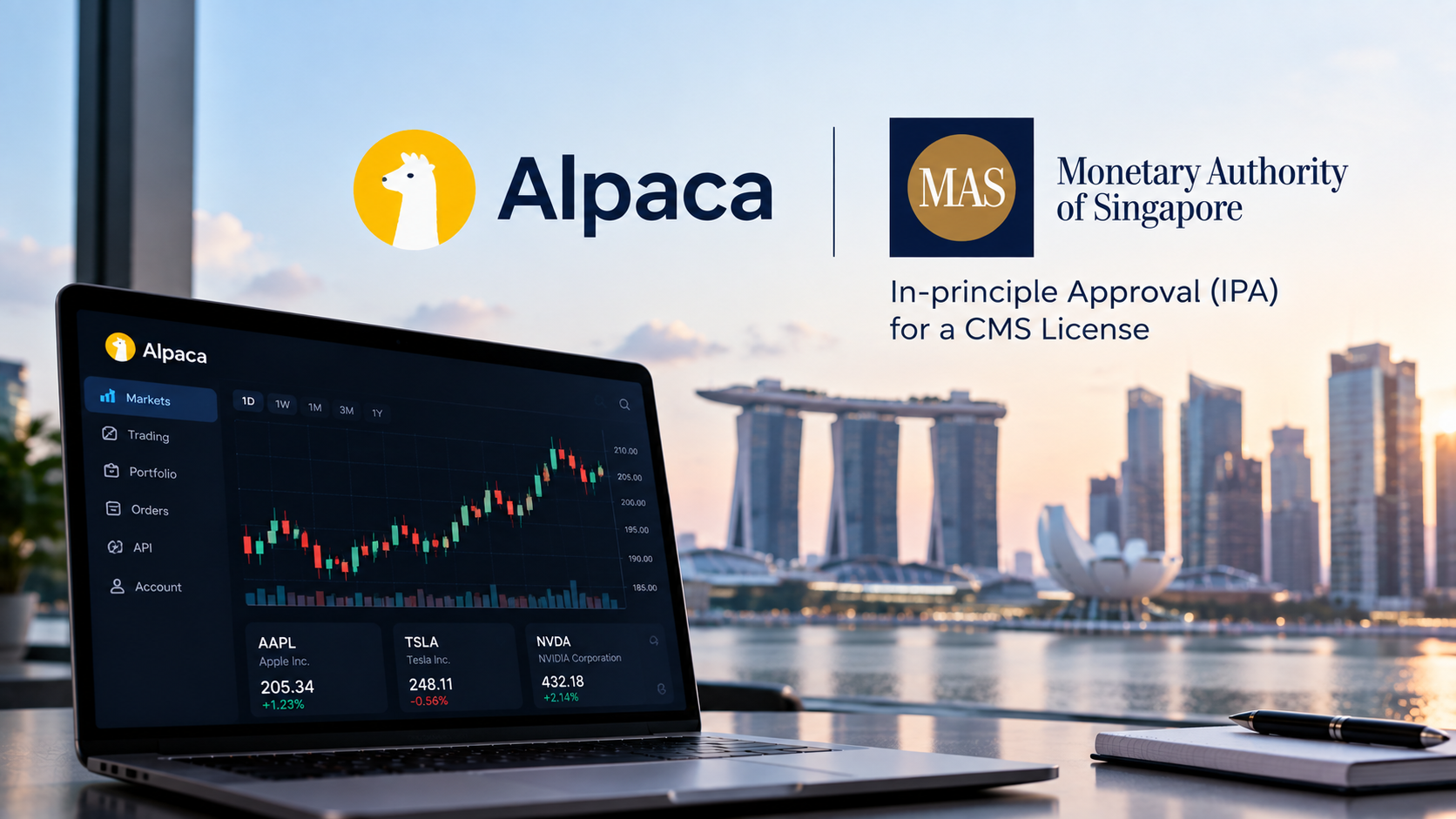
Alpaca has received in-principle approval (IPA) from the Monetary Authority of Singapore (MAS) for a Capital Markets Services (CMS) license, clearing a major regulatory hurdle for the fintech brokerage’s expansion into Southeast Asia. The approval allows Alpaca Securities Pte. Ltd., the company’s Singapore-based subsidiary, to advance toward full licensure and launch brokerage and custodial services in the region.
- Regulatory Milestone: In-principle approval from Monetary Authority of Singapore for Capital Markets Services license
- Services Planned: Brokerage and custodial services, with Alpaca Singapore operating as a local counterparty
- Global Footprint: Alpaca operates across the US, UK, 30 EEA countries, Japan, India, and The Bahamas, serving partners in over 50 countries
- Leadership: Singapore operations led by CEO David Grant, an industry veteran
The approval signals MAS‘ preliminary confidence in Alpaca’s compliance framework and positions Singapore as a hub for the company to support financial institutions across Southeast Asia seeking to meet customer demand for international investment access. The licensing will enable Alpaca to provide locally regulated infrastructure to regional partners looking to expand their market offerings.
As financial institutions across Southeast Asia look to meet growing customer demand for international investing, Singapore is a natural hub for connecting the region’s investors to global markets. This milestone strengthens our ability to support institutions locally with global brokerage infrastructure, regional expertise, and a strong regulatory foundation.
– Rohit Mulani, President of Alpaca Southeast Asia
The Singapore approval extends Alpaca‘s established regulatory presence across major markets worldwide and reflects the company’s commitment to compliance-first infrastructure for fintech partners and institutions. Prospective partners can contact Alpaca’s sales team to explore brokerage services in the region. The IPA remains conditional; MAS reserves the right to rescind approval if material adverse developments occur or specified conditions are not met.